A Robot Economy Publication
The Robotics Brief
Weekly intelligence on robotics markets, machines and money — for serious people.
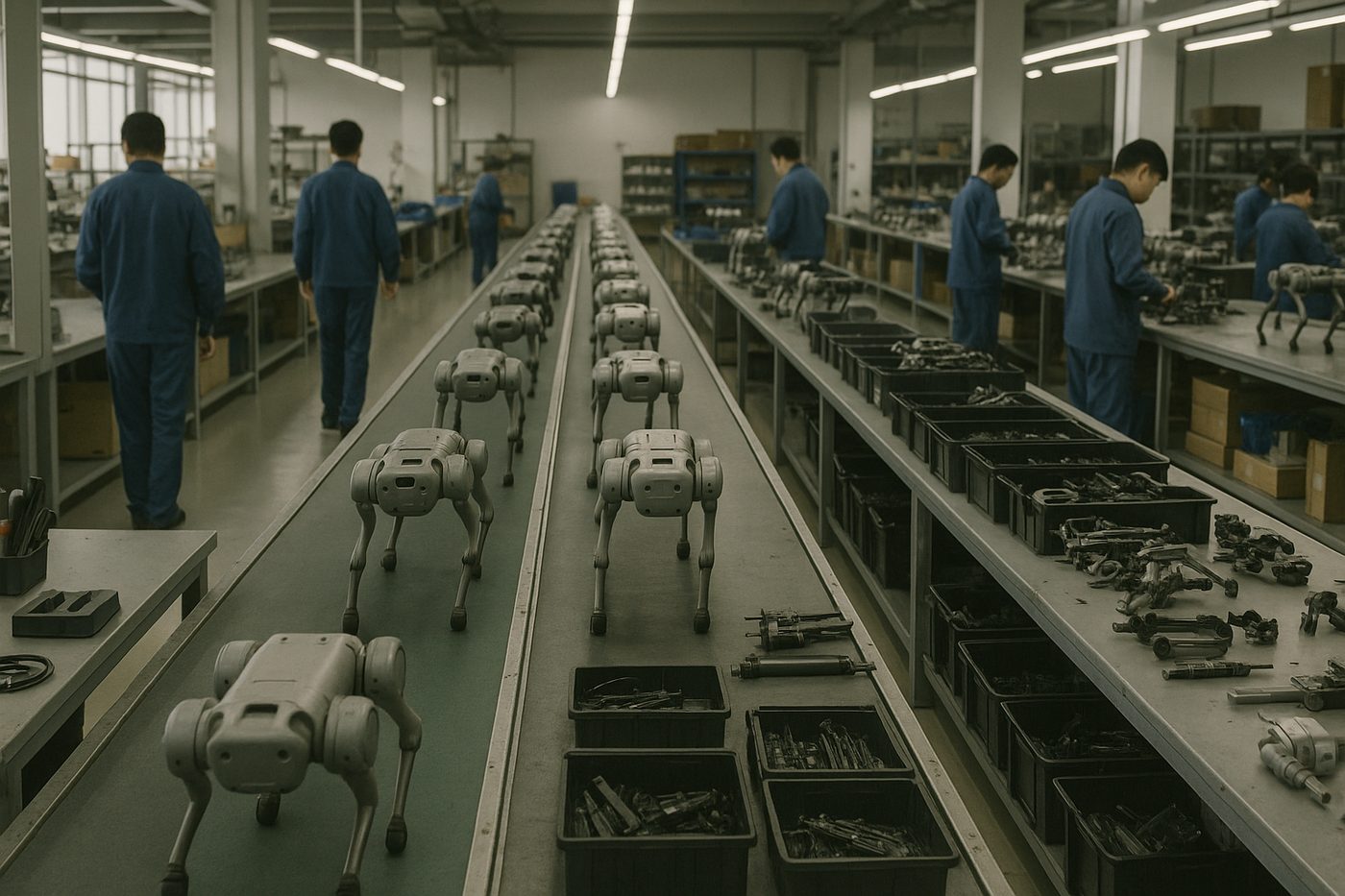
- Issue
- Vol. 1, No. 14
- Coverage window
- Sat, Sep 19, 2026, 12:00 pm CT → Sat, Sep 26, 2026, 12:00 pm CT
- Prepared
- Sat, Sep 26, 2026, 8:12 pm CT
This Week in 60 Seconds
- Unitree and AGIBOT now split global humanoid leadership.
- Capital infusions are fueling rapid production scaling.
- Hardware and AI break new performance records.
1 · From the Editor

Unitree, AGIBOT, and XPENG Redraw the Robotics Map
New capital and manufacturing records drove a deep reshuffle in robotics leadership this week. Unitree Robotics completed its STAR Market IPO at valuations between $9 billion and $7.4 billion—figures cited in two separate Robot Economy records—and shipped its 18,000th humanoid robot, but AGIBOT overtook Unitree in global humanoid shipments for the first half of 2026, according to The Robot Economy. Agility Robotics is set to go public via SPAC at a $2.5 billion valuation, and XPENG Robotics secured $900 million from heavyweight investors including Alibaba and Tencent. Production benchmarks and AI-infused deployments continued at pace: X Square Robot sorted 1,816 parcels an hour in a live test and EngineAI entered live industrial use at Luxshare-ICT. Persona AI has scheduled its Gen 3 humanoid delivery for year-end. Tau Robotics reached operational status without third-party unit confirmation, while Dreame exited the automotive robotics sector due to funding constraints. Partnerships and supply deals signaled deepening ties across the robotics value chain.
Fast technical advances shaped new frontiers in performance and adaptability. The Unitree Superman quadruped hit a leading 12.66 meters per second (The Robot Economy), eclipsing KAIST’s HOUND, which reached 4.25 meters per second. Figure’s humanoid scaled a 15-foot ladder autonomously, while CEO Brett Adcock stated Figure’s systems are now yielding tangible ROI for early customers. AI-driven back-end innovation saw Generalist AI unveil an ultra-fast learning model, OpenAI launch a chip doubling efficiency per watt over Nvidia, and NuScale Power deploy a tool cutting reactor search times by 80%. New policy learning designs, such as Diff-DAgger from the University of Virginia, point toward stronger performance under uncertainty.
Industrial rivalry now intensifies in both the U.S. and Asia. Tesla’s robotics progress is catalyzing imitation and spurring new investments in China, as TechCrunch Robotics reports, while supplier capacity issues threaten to bottle-neck expansion. Meanwhile, Asian firms are shifting from pilots to scaled deployments, as documented by Robotics & Automation News. Strategic cross-border initiatives such as the USA Rare Earth and Pasqal project aim to secure critical components. Investors must now weigh regional competition, capital access, and the speed of innovation as tangible drivers of strategic advantage.
THREE THINGS TO TAKE AWAY
- Unitree and AGIBOT now split global humanoid leadership. Unitree reached a valuation as high as $9 billion according to one Robot Economy record, but AGIBOT led global humanoid robot shipments in 1H 2026, as another Robot Economy record shows.
- Capital infusions are fueling rapid production scaling. XPENG Robotics attracted over $900 million from top Chinese investors per The Robot Economy, while Agility Robotics is planning a $2.5 billion public listing, according to The Robot Economy.
- Hardware and AI break new performance records. Unitree’s Superman quadruped topped 12.66 meters per second (The Robot Economy), and OpenAI’s Jalapeño chip beat Nvidia on energy efficiency by 1.9x, as The Robot Economy notes.
On the radar: Persona AI Gen 3 delivery by year-end; AGIBOT and Unitree ongoing global shipment race; Tesla supply chain responses; future Asian commercial robot deployments; cross-border rare earth supply chain project in progress.
2 · Headlines from the Week
Window: Sat, Sep 19, 2026, 12:00 pm CT through Sat, Sep 26, 2026, 12:00 pm CT.
01 · Unitree Robotics secures as much as $9 billion in STAR Market IPO
Unitree Robotics has completed its IPO on Shanghai's STAR Market, with the Robot Economy record citing a valuation of roughly $9 billion while another Robot Economy record puts the target up to $7.4 billion—two sources giving different figures. Valuation size shows surging interest in industrial autonomous systems and underlines Unitree’s expanding manufacturing and deployment capabilities. The STAR Market listing marks the largest institutional capital event in recent robotics history.
Why it matters. Unitree has strong new capital to scale robot manufacturing with a valuation that sets the bar for private and public robotics plays globally. Verified
02 · Agility Robotics to go public in $2.5 billion SPAC deal
Agility Robotics will list via SPAC at a $2.5 billion valuation, expecting $620 million in proceeds, according to the Robot Economy record. The planned listing signals confidence in Agility’s humanoid business model and product pipeline. Execution of the deal will be closely watched by late-stage investors and competing suppliers.
Why it matters. If successful, this offers a direct public-market comparable for humanoid robotics, opening the IPO window for peers and changing how late-stage capital is allocated. Verified
03 · XPENG Robotics lands $900 million from top China investors
XPENG Robotics raised over $900 million in a financing round from backers including IDG Capital, Alibaba, and Tencent, according to the Robot Economy record. The capital spike signals aggressive scaling ambitions and attracts high-profile institutional LPs to China’s robotics sector. Deployment and supplier management are in focus ahead of year-end production targets.
Why it matters. Large strategic checks drive capacity expansion, intensifying competition with global players and raising capital requirements for new entrants. Verified
04 · X Square Robot sorts 1,816 parcels per hour in live challenge
X Square Robot completed a live, uncut sorting challenge using simple grippers, processing 1,816 parcels per hour, the Robot Economy record shows. The performance demonstrates real throughput at a scale directly relevant to high-volume warehouses. Reliable high-speed, automated sorting sets a benchmark for cost and efficiency in parcel fulfillment.
Why it matters. Every major e-commerce operator is looking for throughput at this level, meaning proven deployments tilt procurement away from less capable automation startups. Verified
05 · EngineAI system operational at Luxshare-ICT factory
EngineAI is now operational at Luxshare-ICT, according to the Robot Economy record. Live deployment at a major manufacturing site signals execution beyond pilot stage, positioning EngineAI for further industrial contracts. Independent unit confirmation is not specified, but operational status shows credible buyer adoption.
Why it matters. Industrial buyers value proof of plant-floor deployment and successful contracts often lead to dominant share in high-volume verticals. Verified
06 · Unitree records 18,000 bipedal humanoid robots manufactured
Unitree’s cumulative manufacturing volume now hits around 18,000 bipedal humanoid robots, the Robot Economy record indicates. This output establishes mass production capabilities for one of the sector’s leaders, though factory-scale deployment has been deliberately limited per CEO Wang Xingxing. The company’s shipping numbers contrast with AGIBOT’s recent market share gains.
Why it matters. Manufacturing at this level pressures suppliers and competitors to match scale, while volume risks cost pressure and operational discipline as humanoid shipments accelerate. Verified
07 · Persona AI plans Gen 3 robot delivery before year-end
Persona AI has slated Gen 3 deliveries for the end of the year, the Robot Economy record shows. This commitment follows teleoperated welding demonstrations in Houston and an announced deployment in South Korea. Execution on the Gen 3 timeline is a critical signal for institutional partners tracking production readiness.
Why it matters. Timely delivery is key for Persona’s credibility with industrial buyers and any slip could turn customers to rivals racing for deployment milestones. Verified
08 · AGIBOT overtakes Unitree in global humanoid shipments in 1H 2026
AGIBOT overtook Unitree in global humanoid robot shipments in the first half of 2026, according to the Robot Economy record. This leadership shift is further supported by AGIBOT claiming top global market share over the same period. The development shows changing buyer preferences as product maturity and field performance become decisive.
Why it matters. Operators and investors must re-evaluate price, reliability, and support as AGIBOT moves from challenger to incumbent in industrial humanoids. Verified
Other Notable Headlines
- Talent: Carbon Robotics launches autonomy program with Great Plains as first partner
- M&A and listings: Google — Meta's Connect turns into a Muse takeover; Cognex to acquire RealSense for $500 million in major expansion into robotic perception and physical AI
- Funding: Generalist — funding signal; Japanese humanoid robotics startup O-ID raises $1.2 million to move modular robot into production; O-ID Raises $1.2M to Build Humanoids With Swappable Parts
- Policy and industrial base: Robo Inc. — other signal; Counterpoint Research — other signal; University of Virginia — product signal; Why Compressed Air is the Most Overlooked Infrastructure Layer in Modern Factory Automation
3 · Public Company Watchlist
Prices as of Sat, Sep 26, 2026, 8:12 pm CT. "Wk %" is the close-to-close change across this issue's coverage window, using the last session at or before each edge. Market cap and price are quoted in each listing's local currency. P/E is trailing; "neg." means the company has negative trailing earnings, "n.a." that the source reports none. Data: Yahoo Finance.
United States and North America
| Ticker | Company | Last | Wk % | Mkt cap | P/E | 52-week range |
|---|---|---|---|---|---|---|
| TSLA | Tesla (Optimus humanoid program) | $372.11 | +2.15% | $1.47T | 344.5 | $297.38 – $498.83 |
| NVDA | NVIDIA (Isaac / Jetson / Halos robotics stack) | $225.07 | +1.26% | $5.43T | 28.5 | $164.27 – $236.54 |
| SYM | Symbotic (warehouse automation systems) | $43.47 | +3.77% | $26.3B | 1086.8 | $37.68 – $87.88 |
| TER | Teradyne (owns Universal Robots, MiR) | $398.38 | +7.24% | $62.3B | 54.6 | $131.75 – $487.91 |
| ROK | Rockwell Automation (industrial controls) | $434.15 | +4.46% | $48.3B | 40.7 | $332.71 – $497.36 |
| ISRG | Intuitive Surgical (surgical robotics) | $405.18 | +3.01% | $145B | 46.5 | $328.57 – $603.88 |
| ZBRA | Zebra Technologies (Fetch AMRs, machine vision) | $370.04 | +6.75% | $17.5B | 33.9 | $199.05 – $386.23 |
| CGNX | Cognex (machine vision) | $58.66 | -4.71% | $9.87B | 57.0 | $34.60 – $72.88 |
| NOVT | Novanta (precision motion, medical robotics) | $143.93 | +8.10% | $5.44B | 91.1 | $98.27 – $176.38 |
| AMBA | Ambarella (edge vision SoCs) | $72.68 | +9.87% | $3.21B | neg. | $48.30 – $96.69 |
| OUST | Ouster (lidar) | $43.72 | +24.74% | $3.15B | neg. | $16.40 – $63.79 |
| AUR | Aurora Innovation (autonomous trucking) | $6.04 | -4.28% | $12.1B | neg. | $3.60 – $8.57 |
| KTOS | Kratos Defense (unmanned systems) | $45.62 | -3.88% | $8.56B | 268.4 | $43.09 – $134.00 |
| SERV | Serve Robotics (sidewalk delivery) | $4.45 | +0.91% | $386M | neg. | $4.17 – $18.64 |
| RR | Richtech Robotics (service robots) | $1.70 | +1.80% | $383M | 24.3 | $1.30 – $7.43 |
| PDYN | Palladyne AI (robotic autonomy software) | $5.39 | -5.11% | $266M | neg. | $4.14 – $10.73 |
| BOTZ | Global X Robotics & AI ETF (sector proxy) | $35.40 | +0.83% | — | 33.7 | $31.88 – $41.71 |
International
| Ticker | Company | Last | Wk % | Mkt cap | P/E | 52-week range |
|---|---|---|---|---|---|---|
| ABBNY | ABB (ADR) — robotics division separation pending | $97.09 | -0.61% | $176B | 35.7 | $67.24 – $110.20 |
| FANUF | Fanuc (ADR) — Japan, factory automation | $38.18 | +0.47% | $35.5B | 34.1 | $27.45 – $55.74 |
| YASKY | Yaskawa Electric (ADR) — Japan, servos and robots | $57.12 | +2.29% | $7.41B | 33.4 | $41.35 – $96.17 |
| OMRNY | Omron (ADR) — Japan, factory automation | $40.20 | +2.84% | $7.90B | 36.9 | $23.23 – $45.24 |
| 6324.T | Harmonic Drive Systems — Japan, precision reducers | ¥6,300 | +1.61% | ¥596B | 370.4 | ¥2,420 – ¥9,150 |
| 2049.TW | Hiwin Technologies — Taiwan, linear motion | NT$325.50 | -2.69% | NT$115B | 49.5 | NT$180.50 – NT$426.00 |
| 454910.KS | Doosan Robotics — Korea, cobots | ₩70,800 | +2.31% | ₩4.59T | n.a. | ₩54,200 – ₩170,000 |
| 277810.KQ | Rainbow Robotics — Korea, Samsung-affiliated | ₩433,000 | -0.69% | ₩8.40T | n.a. | ₩302,000 – ₩979,000 |
| 9880.HK | UBTECH Robotics — China, humanoids | HK$76.70 | -5.13% | HK$38.6B | neg. | HK$74.40 – HK$161.00 |
| 9660.HK | Horizon Robotics — China, robotics and AV silicon | HK$4.03 | -3.93% | HK$64.0B | neg. | HK$3.60 – HK$9.93 |
| 300124.SZ | Inovance Technology — China, motion control | CN¥51.88 | -1.09% | CN¥141B | 29.1 | CN¥49.95 – CN¥91.00 |
| 002747.SZ | Estun Automation — China, industrial robots | CN¥29.35 | -1.48% | CN¥28.4B | 133.4 | CN¥19.21 – CN¥49.00 |
| 300024.SZ | Siasun Robot and Automation — China, industrial robots | CN¥13.22 | 0.00% | CN¥20.7B | neg. | CN¥12.70 – CN¥20.86 |
| XPEV | XPeng (ADR) — China, IRON humanoid program | $10.12 | -4.71% | $9.69B | neg. | $10.05 – $28.24 |
Understanding Stock Insights
- AMBA, OUST, NOVT lead on double-digit moves. Ambarella gained 9.87% to $72.68, Ouster rose 24.74% to $43.72, and Novanta advanced 8.10% to $143.93, all sharply outperforming the robotic component peer group.
- Teradyne, Zebra, Rockwell Automation trade near range highs. Teradyne added 7.24% to $398.38, Zebra Technologies moved up 6.75% to $370.04, and Rockwell finished at $434.15, up 4.46%, each within 12% of 52-week highs and showing the strongest pace among major capital-equipment suppliers.
- Cognex, Aurora, and XPeng move lower. Cognex dropped 4.71% to $58.66, Aurora Innovation lost 4.28% to $6.04, and XPeng also fell 4.71% to $10.12, placing all three closer to their 52-week lows and underperforming relative to peers.
- China automation and robotics mostly lag. Hiwin Technologies fell 2.69% to NT$325.50, Inovance Technology slipped 1.09% to CN¥51.88, Estun Automation declined 1.48% to CN¥29.35, and Siasun Robot was unchanged at CN¥13.22, as industrial robot and motion control names were soft despite wider sector strength.
- Major diversified leaders steady, slight declines in Asia ADRs. ABB (ADR) edged down 0.61% to $97.09, Fanuc (ADR) was up 0.47% to $38.18, and Rainbow Robotics (Samsung-affiliated) slipped 0.69% to ₩433,000, all trading in the lower half of their 52-week ranges with limited volatility.
4 · PRI Movers
No PRI movements in this window.
5 · People, Product, Projects or Plans
One feature each week, drawn from one of the four categories, plus a shorter item from each of the others so the format stays in view. This week's feature is people.
THIS WEEK'S FEATURE · PEOPLE
Figure CEO Brett Adcock Sees Real-World ROI With Humanoids
Figure CEO Brett Adcock asserts that early customers are already seeing real-world return on investment (ROI) from deploying Figure's humanoid robots as companies contend with ongoing labor shortages. Adcock's claim, as captured in the Robot Economy record, points to initial customer experiences that translate directly into financial value, at a moment when manufacturers and logistics operators are struggling to fill critical roles.
The statement comes as industrial buyers evaluate humanoid robots for tasks traditionally handled by human labor, seeking both productivity gains and business continuity. Early ROI signals could encourage more risk-averse sectors to accelerate pilots and longer-term adoption. Figure's focus on directly addressing labor volatility is central to its pitch as economic uncertainty drives a premium on automation with immediate, measurable benefits.
Why Is This Important to Investors? If early ROI claims hold, Figure's current customers benefit from reduced downtime and improved cost structures, driving further adoption across industries facing acute labor gaps. Competitors and suppliers should note the potential for Figure's claims to draw capital and attention away from incremental solutions, especially if these initial returns are validated at scale, according to the Robot Economy record. Verified
ALSO ON DECK
Product · Unitree Superman Quadruped Tops 12.66 Meters Per Second
Unitree’s new Superman quadruped robot achieves a top speed of 12.66 meters per second, the fastest pace recorded for its class this year, according to the Robot Economy record. The company has not disclosed commercial deployment data yet, focusing its announcement on technical performance. This sets a new performance bar for mobile robots designed for logistics and inspection in spacious environments.
Why it matters. Unitree's technical lead may force rivals to accelerate hardware investments or shift R&D priorities, while large-site operators could see operational cycle times fall sharply. Verified
Projects · Tau Robotics Operational But No Independent Unit Confirmed
Tau Robotics says its latest deployment is operational, but there are no independently confirmed units in the field yet, according to the Robot Economy record. While the company stresses operational readiness, third-party validation lags behind the announcement. This gap may affect buyer and partner confidence until verifiable use cases emerge.
Why it matters. Potential customers and investors will watch for outside confirmation of deployments before moving forward with meaningful commitments. Verified
Plans · Dreame Shuts Down ‘Project Starry Sky’ Automotive Robotics
Dreame is shutting down its automotive-focused Project Starry Sky after project funding dried up, based on the Robot Economy record. The decision follows months of uncertainty as capital access tightened, leading to the cancellation of an ambitious mobility automation initiative. All signals point to a completed wind-down with no restart planned.
Why it matters. Competing projects could face less competition for talent and contracts, but this exit is a sharp warning for robotics teams with single-project dependencies and weak funding pipelines. Verified
6 · Partnerships and Supply Deals
- Unitree Robotics partners with DeepSeek — strategic partnership for embodied AI humanoid robot development (Robot Economy record)
- RoboStore is a customer of Unitree — RoboStore is a top distributor of Unitree robots. (Robot Economy record)
- Teledyne FLIR OEM is a customer of U.S. Army — Teledyne FLIR OEM will help the U.S. Army develop smaller, cheaper, and more capable thermal sensors for drones (Robot Economy record)
7 · From the Workshop
How these machines are actually built and operated: components, safety architecture, data pipelines, compute and software cadence.
1. Quadruped speed reaches 4.25 meters per second · Sept 25
KAIST DRCD Lab’s HOUND quadruped now achieves a top speed of 4.25 meters per second, according to the Robot Economy record. This puts HOUND at the upper tier of legged robot mobility. The specification sets a performance benchmark for all-weather ground robots expected to maneuver across industrial and tactical environments.
Why it matters. Higher speed expands feasible operational windows and site coverage, lowering deployment costs where human or wheeled options fail. Verified
2. Humanoid robot climbs 15-foot ladder autonomously · Sept 25
Figure AI’s Figure 03 humanoid robot demonstrated autonomous climbing of a 15-foot ladder for industrial mezzanine access, as the Robot Economy record details. This task targets a key gap in operational utility for warehouse and plant robots, previously limited by vertical mobility constraints. Integration with existing platforms may require new stability and safety protocols for working at height.
Why it matters. Robots able to negotiate vertical infrastructure could replace certain hazardous human jobs and ease retrofit integration in legacy sites. Verified
3. Foundation model learns new physical tasks in seconds · Sept 25
Generalist AI has unveiled GEN-1.5, a foundation model that learns novel physical tasks in seconds from a single prompt, according to the Robot Economy record. GEN-1.5 compresses training time dramatically compared to typical learning cycles, spanning across domains and hardware platforms. Comparative reliability and transfer fidelity will be key for production use.
Why it matters. The reduction in onboarding and retraining costs could swing economic decisions in automation-first environments. Verified
4. AI tool cuts reactor engineering search time by 80% · Sept 25
NuScale Power is deploying AI tools built specifically for nuclear engineering, which help project engineers cut reactor development search time by 80%, according to the Robot Economy record. The deployment promises faster knowledge retrieval, accelerated iteration, and potential reduction in compliance overhead. Proprietary AI will require continual retraining against evolving regulations.
Why it matters. Faster document and past-case access means major cost savings and compressed project schedules in the safety-critical nuclear sector. Verified
5. Custom AI chip doubles efficiency per watt over Nvidia · Sept 25
OpenAI announced Jalapeño, its first custom AI inference chip, delivering 1.9 times more efficiency per watt than current Nvidia systems, the Robot Economy record indicates. Jalapeño may reset baseline energy and throughput expectations for internal inference workloads, especially at scale. Real-world performance and production volume remain to be benchmarked.
Why it matters. Cost drops for high-volume AI inference hardware could force recalculations on cloud energy spend and server allocation. Verified
6. Diff-DAgger improves robot uncertainty estimation · Sept 25
Yen-Ling Kuo at the University of Virginia introduced Diff-DAgger, a new policy learning approach using diffusion processes to enhance robot task completion and uncertainty estimation, per the Robot Economy record. This mechanism improves adaptation in environments where model errors or data distribution shifts are likely, and may integrate with large foundation models (see Headlines).
Why it matters. Improved uncertainty handling decreases failure rates, allowing more solid deployment in sensitive logistics and medical use. Verified
Watch item: Real-world throughput of OpenAI’s Jalapeño inference chip will be a primary supply-chain variable for large-scale AI deployments, according to the Robot Economy record.
Learning More About Robotics with The Robot Economy
8 · Made in the USA
The week's cross-cutting story: Tesla’s robotics push draws rivals and reveals supply risks
Tesla’s humanoid robot program drove both competitive and supply chain headlines this week. Chinese automakers are now investing in robotics after seeing technical progress at Tesla, according to TechCrunch Robotics. Meanwhile, Tesla’s hardware supply strategies drew scrutiny, and Apptronik’s CEO independently warned about severe U.S. gear and actuator shortages. Expansion for U.S. robotics may depend as much on domestic parts sourcing as it does on new software and capital. Reported
Company roundup
Tesla · Austin, TX
Tesla’s humanoid program advanced on new technical and supply chain disclosures. Gen3 Optimus renders appeared in Tesla’s Android app, but revealed only non-final assets with no working interface, Humanoids Daily noted. Training plans using Berlin factory workers resurfaced without details on current scale, while app code pointed to Optimus charging and home integration features—still without confirmed consumer readiness. Chinese automakers are now pursuing similar robotics bets as Tesla, TechCrunch Robotics reported.
Why it matters. Tesla’s head start is eroding as rivals move aggressively and supply dynamics cloud timelines. Watch for capital pivots to suppliers or new integrators. Reported
NVIDIA · Santa Clara, CA
NVIDIA launched the Jetson Orin Nano 2, a compact robotics computer capable of 78 trillion operations per second for edge AI, Robotics & Automation News reported. Open-source packages for Robotiq adaptive grippers and a new Isaac ROS 5.0 release—both with expanded support for AI agents—now anchor NVIDIA’s play for robotics application development.
Why it matters. NVIDIA is tightening its grip on robotics compute and developer tooling, increasing dependency from hardware and AI startups building on its stack. Reported
Skild AI · Pittsburgh, PA
Skild AI reached $100 million in annual recurring revenue just 10 months after commercial launch, with over 60 paying customers, Robotics & Automation News said. The S1 robot demonstrated real-world soccer play after training through more than 140 years of simulated self-play, as the company detailed at Humanoids Daily.
Why it matters. Skild’s rapid ARR ramp validates buyer demand for high-adaptability robot AI and raises the bar for learning-based competitors with slower customer cycles. Reported
Agility Robotics · Salem, OR
Agility Robotics announced a deployment in Fremont, California, according to the Robot Economy record. No further unit count, timeline or customer identity was disclosed.
Why it matters. Agility’s market reach is growing in high-value U.S. logistics zones, but the opacity restricts second-order signals for suppliers or investors. Verified
Apptronik · Austin, TX
Apptronik CEO Jeff Cardenas warned that U.S. humanoid builders are running into steep domestic gear shortages, Humanoids Daily reported. Cardenas said actuator costs can account for 60% of the parts bill, propelling Apptronik to expand local sourcing.
Why it matters. Supply chain risk now shapes go-to-market timelines and cost structures, with domestic hardware integration becoming a core strategic challenge for U.S. robot OEMs. Reported
Common Vector Robotics · Detroit, MI
Common Vector Robotics secured $425,000 by winning Michigan University’s PitchMI Startup Competition’s defense and aerospace semifinal, as well as an added $50,000 from 20Fathoms, for its rugged ground robots, Robotics & Automation News reported. The funds target commercial expansion for ground robotics in security-sensitive markets.
Why it matters. This win signals institutional appetite for rugged robot startups serving defense, not just warehouse or logistics verticals. Reported
Also active this week
- Toyota Research Institute — funding signal. Awarded Yen-Ling Kuo Young Faculty Researcher Award to advance car reasoning research. (Robot Economy record) Verified
Quiet this week: 1X Technologies, Anduril, Aurora Innovation, Boston Dynamics, Bright Machines, Carbon Robotics, Chef Robotics, Cognex, Diligent Robotics, Figure AI, Intuitive Surgical, Locus Robotics.
9 · International and China
The week's cross-cutting story: Robot arms and humanoids both enter mass deployment, broadening Asia’s robotics lead
This week, Asian robotics makers from Epson and XPeng to AgiBot advanced their commercial reach, with Epson launching its first collaborative robot arm and XPeng accelerating plans for humanoid production and in-store deployments. AgiBot scaled up to over 300 robots in a single theme park deployment, emphasizing real-world application at volume. RLWRLD used a major Seoul conference to promote a “deployment-first” model for industrial humanoids. The Robotics & Automation News illustrates manufacturers’ shift from isolated pilots to scaled, operational rollouts, boosting Asia’s relevance in the industrial and service robotics race. Material expansion into routine and high-profile environments increases competition across both hardware and AI-led design. Reported
China — humanoid developers
XPeng · Guangzhou, China
XPeng has secured supplier agreements for its humanoid IRON and is moving to year-end production after its first partner conference, according to Humanoids Daily. The company demonstrated IRON’s real-time interaction and memory of car buyers in a showroom test ahead of forecasted retail site deployments, as reported by the same outlet. These steps move XPeng’s humanoid strategy past prototype, toward retail service scale.
Why it matters. XPeng is signaling an operational phase for commercial humanoids, pushing competitors to speed up both their supply chains and on-site deployments or risk lagging in a crucial segment. Reported
AgiBot · Shanghai, China
AgiBot and Chimelong have jointly deployed over 300 robots across Spaceship Park in Zhuhai, supporting performances, visitor guidance and hotel services, as covered by Humanoids Daily. This collaboration also launched a research institute focused on tourism robotics. The scale and scope of the project reflect AgiBot’s service robotics ambitions.
Why it matters. Large deployments in the leisure sector set a new benchmark for volume and complexity, giving AgiBot real-world feedback and operational use that could accelerate future sales to hospitality and events operators. Reported
Europe, Japan and Korea
Epson · Suwa, Japan
Epson launched the AX6, its first collaborative robot, expanding its six-axis robot line with a lightweight, force- and power-limited cobot. The AX6 is designed for applications requiring close interaction between robots and human workers and features no-code programming for easier deployment, according to The Robot Report and Robotics & Automation News. The addition solidifies Epson’s entry into the collaborative robot market, targeting factories that need flexible and safe automation.
Why it matters. Manufacturers looking to upgrade manual assembly lines with cobots have new, lower-friction tools to integrate, and Epson’s entry adds price and margin pressure on incumbents in the collaborative arm category. Reported
Comau · Turin, Italy
Comau has delivered a turnkey battery cell formation and testing system to Slovenia’s National Institute of Chemistry, bringing industrial scale manufacturing and testing capabilities into the lab, Robotics & Automation News reports. The system supports materials validation and product development with reconfigurable processes meeting lab flexibility needs. This investment deepens Comau’s relationship with European advanced materials research.
Why it matters. Suppliers to the battery and EV value chain should note how automation is bridging lab and plant, shortening time-to-market for new cell chemistries and manufacturing methods. Reported
RLWRLD · Seoul, Korea
RLWRLD detailed a “deployment-first” strategy for industrial humanoids during the Humanoids Summit Seoul 2026, speaking as a featured collaborator at the event, according to Robotics & Automation News. The company aims to prioritize immediate real-world application of physical AI for humanoids over extended prototype cycles. RLWRLD’s platform focus seeks to accelerate feedback loops and close contracts faster.
Why it matters. Humanoid startups pushing direct deployment could bypass traditional pilots—winning business by solving unmet operational needs faster than incumbents with longer validation processes. Reported
Stäubli · Pfäffikon, Switzerland
Stäubli Robots is integrating custom protective bellows from Eclore Actuators across its SCARA robot line after a two-year partnership, as presented at Interpack in Düsseldorf, Robotics & Automation News writes. The upgrade targets hygiene and reliability for robots working in sensitive and demanding environments. Adoption marks a new tier of durability for Stäubli’s product line.
Why it matters. Customers in food, pharma and cleanroom settings now face fewer life-cycle tradeoffs with automation, tightening competition among SCARA vendors on performance and compliance. Reported
Quiet this week: ABB, Aldebaran, Deep Robotics, Doosan Robotics, Einride, EngineAI, Estun, Exotec, Fanuc, Galbot, Hai Robotics, Harmonic Drive Systems.
Policy, export controls and components
- USA Rare Earth and Pasqal have initiated a joint project blending quantum AI and robotics to bolster the U.S. rare earth supply chain, according to Interesting Engineering. The program, reported September 19, specifies a cross-border tech strategy for components critical to energy and automation manufacturing. Reported
10 · New on the Record
International
- Tau Robotics — Operator · San Francisco (Robot Economy record)
- Persona AI — Robot maker (Robot Economy record)
- Nucleus — Robot maker (Robot Economy record)
- DeepSeek — Capital (Robot Economy record)
- Dyna Robotics — Robot maker (Robot Economy record)
- X Square Robot — Robot maker (Robot Economy record)
- Foundation — Robot maker (Robot Economy record)
- LG — Robot maker (Robot Economy record)
- Figure — Robot maker (Robot Economy record)
- Schaeffler — Component supplier · Germany (Robot Economy record)
- Robo Inc. — Integrator (Robot Economy record)
- RoboStore — Integrator (Robot Economy record)
11 · Upcoming Events
Conferences, trade shows, workshops and meetups ahead. Dates are verified against organiser sites; unconfirmed entries are labelled rather than dropped.
| Event | Location | Dates | Why it matters |
|---|---|---|---|
| IROS 2026 | Pittsburgh, PA | Sept 27 – Oct 1, 2026 | Largest autumn academic robotics conference; recruiting ground and technical bellwether. |
| Bots, Bevs & Devs | SF Bay Area | Oct 7, 2026 | Demo-and-networking night for robotics founders and engineers. |
| CIIF 2026 (China Int'l Industry Fair) | Shanghai, China (NECC) | Oct 12–16, 2026 | Asia's premier industrial trade event and main showcase for Chinese robot supply chains. |
| PACK EXPO International | Chicago, IL | Oct 18–21, 2026 | Biennial packaging megashow; a primary sales channel for cobots and end-of-line robotics. |
| RoboBusiness 2026 | Santa Clara, CA | Oct 20–21, 2026 | Commercial robotics: business models, funding, supply chain, go-to-market. |
| RobOpsCon 2026 | Mountain View, CA | Oct 22, 2026 | One day on scaling robot operations: fleet ops, reliability, deployment economics. |
| A3 International Robot Safety Conference | Detroit, MI | Nov 3–5, 2026 | North American venue for robot safety standards and emerging humanoid safety practice. |
| CoRL 2026 | Austin, TX | Nov 9–12, 2026 | Premier robot-learning venue; where robot foundation-model results land first. |
| Humanoids Summit Silicon Valley | San Mateo, CA | Dec 1–2, 2026 | Densest US concentration of humanoid founders, suppliers and investors. |
| IEEE-RAS Humanoids 2026 | Santa Clara, CA | Dec 7–9, 2026 | Flagship academic humanoid conference, in Silicon Valley for the first time. |
| CES 2027 | Las Vegas, NV | Jan 6–9, 2027 | Consumer humanoid showcase; Samsung is reported to be targeting a prototype reveal here. |
| A3 Business Forum 2027 | Orlando, FL | Jan 18–20, 2027 | Executive and investor forum: order-book guidance, market data, M&A. |
| HANNOVER MESSE 2027 | Hannover, Germany | Apr 5–8, 2027 | World's leading industrial fair and Europe's main Physical AI stage. |
| ProMat 2027 | Chicago, IL | Apr 19–21, 2027 | North America's biennial material-handling show; largest venue for warehouse robotics and AMRs. |
| Automate 2027 | Las Vegas, NV | May 10–13, 2027 | Biggest North American robotics exhibition. Note: Las Vegas, not Detroit — several aggregators still list the old venue. |
| ICRA 2027 | Seoul, South Korea (COEX) | May 24–28, 2027 | Robotics' flagship conference and the largest annual academic-industrial gathering. |
| Robotics Summit & Expo 2027 | Boston, MA | Dates unconfirmed (aggregators: June 2–3) | Main US technical conference for people building commercial robots; RBR50 gala co-located. |
| RoboNext 2026 / iREX 2027 | Japan | Dec 2026 / early Dec 2027, dates TBA | Japan's biennial robotics megashow and its new off-year edition; component supply chain in force. |
Calendar notes
- Editor's Note
- The coming quarters will test the mettle of both established robotics players and startups as generative AI integration, labor cost pressure, and shifting global supply chains accelerate product cycles. Humanoid robots, once academic showcase, are now a focus of industrial and commercial pilot programs, with fresh rounds of capital targeting scale and reliability over basic proof of concept. Meanwhile, China's domestic robot supply base continues to mature, controlling more of its value chain and pushing outbound sales in service and logistics verticals.
- Technical conferences this cycle are straddling academic and commercialization agendas more sharply than in prior years. Events like IROS 2026 and IEEE-RAS Humanoids will form core recruiting and technical benchmarking venues, but the most pivotal deals and supply chain wins are discussed in parallel-track networking nights and business-centric summits clustered across a tight 6–10 week window in North America and East Asia.
Methodology and Standards
- Coverage window. One press-time cutoff to the next, stated at the top of the issue. Anything material that reached the record between the cutoff and publication appears in a clearly labelled Late breaking block rather than being folded into the main headlines.
- Evidence hierarchy. The verified record ranks above regulatory filings, which rank above reported items, which rank above company claims. Every item carries a small evidence tag — Verified, Filing, Reported or Claimed — rather than a label in the prose. Pre-orders, letters of intent and pipeline figures are never presented as revenue.
- Sourcing. Every item names its source once, inline, as a link to the page it came from: the outlet for reported items, the Robot Economy company record for verified record entries. Where several outlets carried a story we link one — a filing first, otherwise the most recent report — and the others inform the text. Where a company had no verifiable news in the window, we say so rather than reprinting an older release.
- Double-counting controls. Syndicated stories are counted once: items sharing a normalised headline collapse to a single entry, and a story is told in full in one section only, with later sections cross-referencing it in a clause. Adoption metrics and shipment metrics are kept separate, and where published statistics conflict both are shown, each attributed, with the conflict flagged.
- Market data. The watchlist shows, per ticker, the last price, the close-to-close change across the coverage window ("Wk %", using the last session at or before each edge), market capitalisation, trailing P/E and the 52-week range, from Yahoo Finance as of the run date and in each listing's local currency; "neg." marks negative trailing earnings and "n.a." a ratio the source does not report. The email edition carries ticker, last price and Wk % only; the full seven-column table is on the web issue.