The paid edition
Everything plus the Brief
$8 / month
Public companies, capital, supply chains and analysis. Every Monday, every claim tagged and sourced.
SubscribeCharter price, locked for three years.
A Robot Economy Publication
Weekly intelligence on robotics markets, machines and money — for serious people.
One feature each week, drawn from one of the four categories, plus a shorter item from each of the others so the format stays in view. This week's feature is projects.
THIS WEEK'S FEATURE · PROJECTS
Ultra has raised $50 million in Series A funding to expand its warehouse robotics business and deepen its partnership with Physical Intelligence, bringing total announced funding to $62 million including its prior seed round, according to Humanoids Daily. The round was led by Framework Ventures, with Y Combinator participating, and follows an earlier seed investment from Y Combinator and NextView. The new capital aims to accelerate deployment of Ultra’s stationary warehouse robots, with CEO Jon Miller Schwartz confirming a model that charges customers integration fees and monthly support.
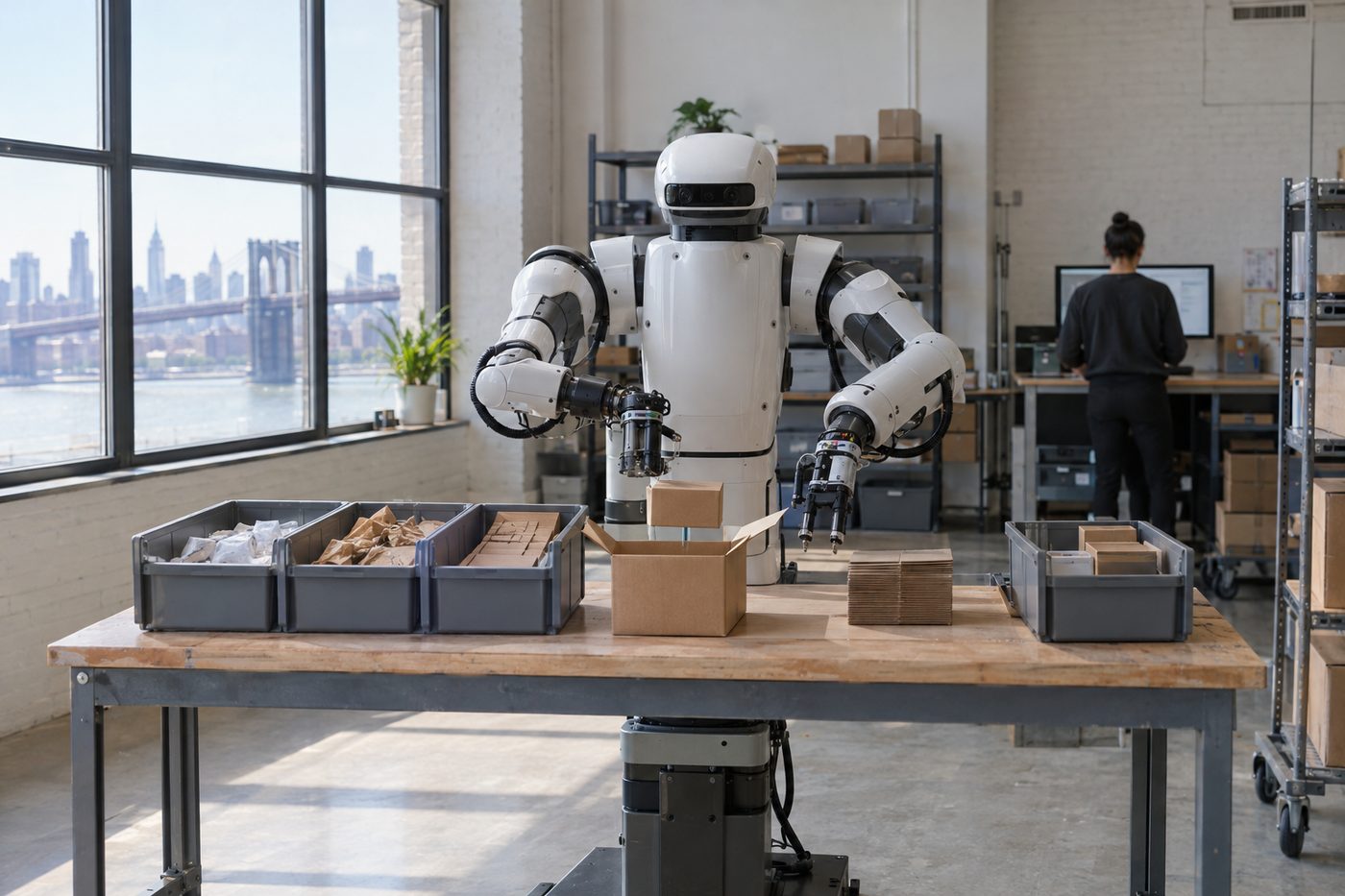
The Brooklyn-based company relies on task-focused hardware integrated with Physical Intelligence’s AI models to automate order packing, sorting, and kitting. Ultra’s OP1 robot operates from a stationary position on locking caster wheels, targeting manipulation at workstations rather than warehouse traversal. The robots handle payloads up to 10 pounds per arm and use standard 120-volt power, with a five-by-five-foot footprint. Ultra has already deployed systems across sites in New York, Georgia, New Jersey and Texas, with the company claiming its robots have packed more than 500,000 orders.
Physical Intelligence’s models underpin Ultra’s system autonomy, with recent deployments achieving 96.4% autonomy over a full warehouse shift as measured during a reported shift using the π0.6 model generation, Humanoids Daily writes. Human operator interventions are still required when the model encounters an unfamiliar issue, ensuring correct workflow and feeding new experience data into subsequent AI model improvements. Ultra’s business structure allows it to focus on hardware and operations while using specialized models from independent AI developers.
The ongoing collaboration between Ultra and Physical Intelligence pre-dates this funding but grows more explicit and central as its robot service scales. Recent feedback from both parties points to increased throughput and reliability with each model generation and validates the model of integrating external AI, not just for development speed but for continuous post-deployment upgrades. Physical Intelligence also benefits from real-world deployment data outside laboratory settings, an valuable differentiator as robotics firms look to close the gap between research and persistent commercial operations.
Why Is This Important to Investors? Ultra’s mix of recurring revenue, hardware specialization and external AI partnership offers a preview of how robotics service provision could be structured across highly competitive and repetitive workflows. Investors and customers should watch how Ultra’s operational autonomy and customer support scale, as the cost of maintaining effective AI and human support is the principal variable in determining gross margin and defensibility in warehouse robotics, Humanoids Daily notes. Reported
ALSO ON DECK
Boston Dynamics has appointed former Amazon AI leader Rohit Prasad as CEO, effective October 7, as the company advances AI and commercialization in robotics, according to Humanoids Daily. The move follows Robert Playter’s February retirement and CFO Amanda McMaster’s interim leadership. Prasad led Alexa, developed the Amazon Nova model family, and spent nearly 14 years at Raytheon BBN Technologies before joining Boston Dynamics.
He is expected to join the board, pending approval, and will oversee the broadening of Boston Dynamics' product portfolio, including Spot, Stretch, and Atlas. The company has signaled an intent to bring more advanced AI into its robots targeting industrial and commercial uses, with hardware development—such as new four-finger hands for Atlas—continuing in parallel, Humanoids Daily states.
Why it matters. Boston Dynamics is betting on leadership with deep AI, cloud, and product experience as it turns R&D advances into profitable commercial lines. The appointment increases competitive pressure for robotics incumbents and startups pursuing general-purpose machines. Reported
Monolithos has launched a public alpha of Robot Brain, its long-term memory and experience platform for robots and embodied AI, according to Robotics & Automation News. Robot Brain preserves robots’ task histories, human corrections, and failures—making past experiences available for future planning. The system is currently available as Alpha 0.1 for Apple Silicon macOS and ARM64/x86-64 Linux.
Robot Brain operates as a separate context and recall service, supplying robots with relevant experience without replacing their existing planning or control software. Monolithos says developers may test the platform’s memory ingestion and recall features before integrating it into physical robots, simulators, or training environments, Robotics & Automation News writes.
Why it matters. Making robot experience truly persistent is a precondition for accumulative learning at robotic scale. Widespread deployment is possible only if robots can recall and reason over their own histories—reducing repeated failures and costly interventions. Reported
Schneider Electric confirmed a $22.6 billion acquisition of PTC Inc., a move the company says will help it bridge digital and physical operations from design through manufacturing, The Robot Report writes. The deal extends Schneider’s industrial reach, pairing its operational expertise with PTC’s CAD and SaaS platforms such as Creo and Codebeamer.
Neil Barua, president and CEO of PTC, identified the opportunity to create a “digital thread” from engineering through to shop floor, maintenance and compliance. Industry analyst Matthieu Kulezak stated the move positions Schneider as a stronger rival to Siemens in industrial automation and software, The Robot Report notes.
Why it matters. The integration, if realized, threatens to reorder market share among industrial automation giants. Robotics and machine-building teams could benefit from earlier access to Schneider’s expanded software suite, creating pressure on rivals to match digital continuity. Reported
Why we publish
The robot economy is being built right now, in filings, factory floors and funding rounds most people never read.
The Robot Economy reads them every week so you can act before the headlines. Robotics Weekly is free, for everyone following the shift. The paid edition adds the Brief, for operators and investors who have to act on it.
The paid edition
$8 / month
Public companies, capital, supply chains and analysis. Every Monday, every claim tagged and sourced.
SubscribeCharter price, locked for three years.
Try it first
Read four Monday issues of the paid edition on us. No card up front. Keep it at the charter price or walk away.
Start my free monthFree download
Vol. 1: twelve charts on where the machines, the money and the jobs are going.
Download the e-book