The paid edition
Everything plus the Brief
$8 / month
Public companies, capital, supply chains and analysis. Every Monday, every claim tagged and sourced.
SubscribeCharter price, locked for three years.
A Robot Economy Publication
Weekly intelligence on robotics markets, machines and money — for serious people.
One feature each week, drawn from one of the four categories, plus a shorter item from each of the others so the format stays in view. This week's feature is product.
THIS WEEK'S FEATURE · PRODUCT
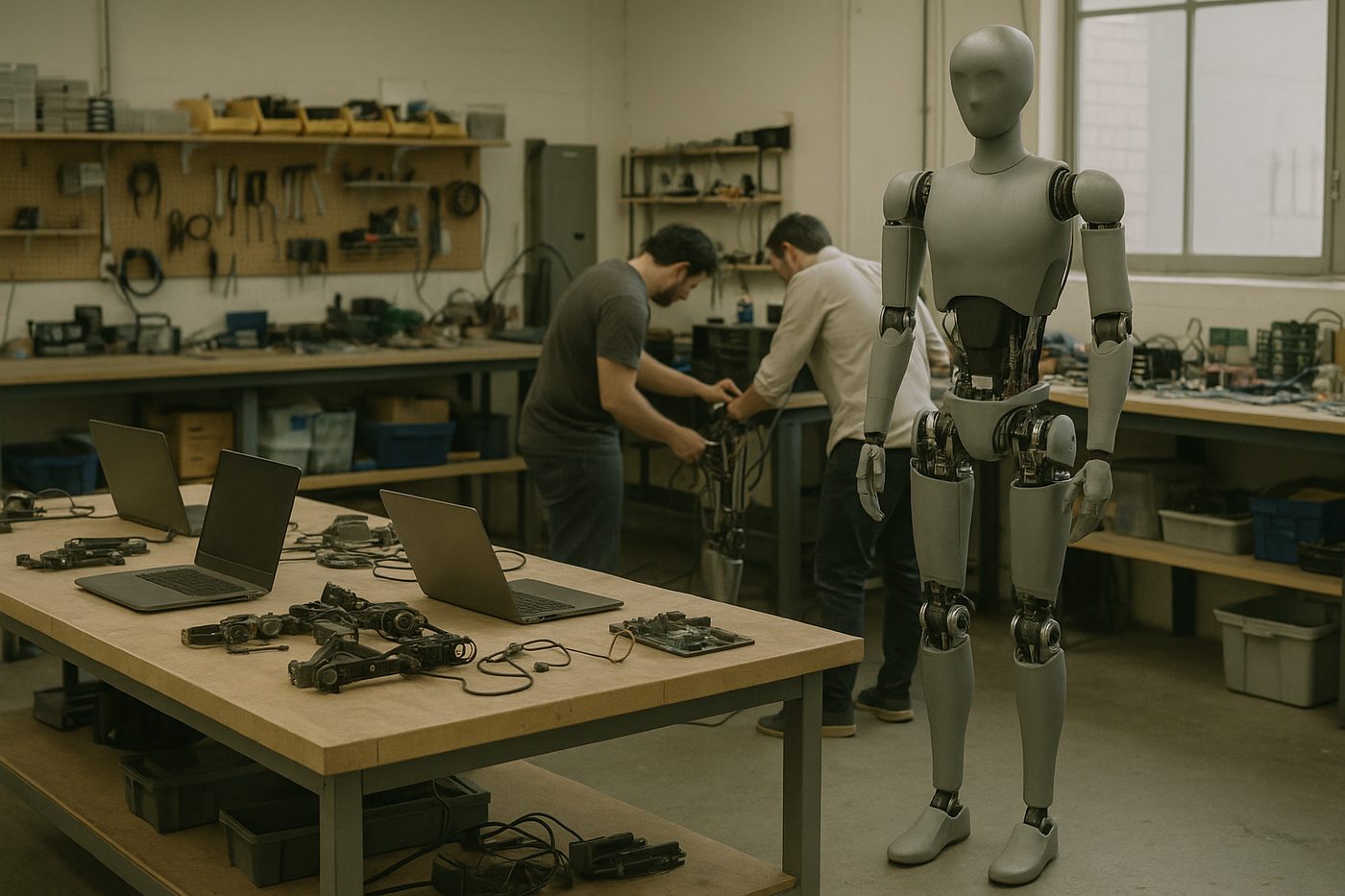
RoboParty introduced its RP1 humanoid robot at the IROS conference, demonstrating advanced balance-recovery capabilities and targeting developers as an initial user group. The company built the RP1 from the technological foundation of ROBOTO ORIGIN, and announced intentions to make both hardware and software more broadly accessible in the fourth quarter of this year, aiming to catalyze open-source innovation in humanoid robotics. According to Humanoids Daily, the developer version’s public debut signals a new phase for startups and research groups seeking to test and extend full-size bipedal machines.
RoboParty’s open-source strategy could lower traditional barriers for entry into humanoid robotics R&D, shifting some of the competitive advantage away from vertically integrated companies and toward distributed communities and early-stage players. The platform’s emphasis on balance recovery and open hardware further distinguishes it from projects that limit access to software or isolated APIs. That roadmap aligns with a wave of industry efforts to accelerate humanoid adoption in applications requiring adaptability and physical competence.
Why Is This Important to Investors? Broader access to the RP1 could speed the influx of talent and experimentation in humanoid robotics, challenging established competitors and reshaping the market’s innovation curve. Startups and integrators stand to benefit from cost-efficient prototyping, while closed-source incumbents may face lower technical moats as open hardware and software lowers switching frictions and enables shared progress. Reported
ALSO ON DECK
Aseon Labs CEO George Kalligeros says servicing constraints, not just absence of a human driver, will define the robotaxi industry’s pace as fleets scale, according to Robotics & Automation News. His company has raised $10 million from investors including Crane Venture Partners and Expa to develop autonomous “pit stop” pods that handle inspection, charging, and cleaning inside robotaxi operating zones. Each servicing pod, using industrial robotic arms and cameras, targets a 30-minute complete turnover cycle.
The portable pods can inspect for rubbish, lost property, and surface cleanliness, with future expansion planned for automated calibration and component swap-out, according to Robotics & Automation News. Kalligeros, a former Tesla engineer and Pushme co-founder, sees distributed servicing as a way to minimize off-route downtime and unify maintenance across fleet operators.
Why it matters. Robotaxi growth depends on solving labor and land constraints for in-field maintenance. Investors and mobility operators should watch whether distributed pods achieve performance and reliability outside controlled demos. Reported
Agility Robotics and FORT Robotics will jointly develop an integrated safety architecture for Digit 5, Agility’s next-generation humanoid, building on a multi-year collaboration, according to Robotics & Automation News. Their three-part design includes a safety pendant, on-robot communications, and new off-robot interfaces extending human detection and safety cues beyond the hardware shell. FORT’s interface is meant to link Digit 5 with warehouse and factory systems, broadening Agility’s safety engineering to complex, real-world deployments.
Past versions of Digit have logged more than 65,000 hours across deployments at Schaeffler, GXO, and Toyota Motor Manufacturing Canada, with the new architecture expected to scale safety and regulatory compliance as robots take on human-proximate work. The agreement formalizes future joint hardware development, deployment support, and regulatory strategy, according to Robotics & Automation News.
Why it matters. As humanoids approach broader industrial deployment, solid and certifiable safety systems become table stakes. FORT and Agility’s partnership may define practical standards, challenging rivals to match integrated risk controls. Reported
Agility Robotics and FORT Robotics are preparing to go public via reverse merger, according to Robots & Startups (Andra Keay). Their public market moves come against a September total of $4.86 billion raised across 167 robotics funding rounds—more rounds but less capital than July or August. Clear deals include Qualcomm’s acquisition of PickNik Robotics, SoftBank Group’s push to acquire RAI from Hyundai, and Cognex’s $500 million RealSense buy.
Both Agility and FORT are showing strategic partnerships as they approach the public markets, with Agility’s Investor and Analyst Day scheduled for October 6. No revenue metrics or valuation estimates were specified in the Robots & Startups (Andra Keay) update.
Why it matters. Reverse mergers remain a path for robotics firms seeking scale before hitting traditional IPO benchmarks. Public debut plans and major funding flows will test investor appetite for capital-intensive automation businesses in the current cycle. Reported
Why we publish
The robot economy is being built right now, in filings, factory floors and funding rounds most people never read.
The Robot Economy reads them every week so you can act before the headlines. Robotics Weekly is free, for everyone following the shift. The paid edition adds the Brief, for operators and investors who have to act on it.
The paid edition
$8 / month
Public companies, capital, supply chains and analysis. Every Monday, every claim tagged and sourced.
SubscribeCharter price, locked for three years.
Try it first
Read four Monday issues of the paid edition on us. No card up front. Keep it at the charter price or walk away.
Start my free monthFree download
Vol. 1: twelve charts on where the machines, the money and the jobs are going.
Download the e-book